

What Is Ice Wine?
Ice wine is a naturally sweet wine made from grapes that freeze on the vine before harvest. When pressed while still frozen, the water remains locked inside the berry as ice crystals while concentrated sugars and acids flow out as a small amount of intensely flavored juice. The wine is not made sweet by adding sugar or stopping fermentation artificially — the sweetness emerges from the physics of freezing water out of the grape before fermentation begins. Winter itself is an ingredient in the finished wine.
How the Freezing Process Works
Grapes are composed largely of water, along with dissolved sugars, organic acids, and aromatic compounds. When temperatures fall below approximately minus eight degrees Celsius — around seventeen degrees Fahrenheit — the water inside the grape begins to freeze. Sugars and acids do not solidify at the same temperature, which creates a natural physical separation between ice and concentrated juice inside the berry.
When frozen grapes are pressed immediately after harvest — while still completely frozen — the water remains behind in the press as ice while the concentrated liquid flows out slowly. The resulting must contains dramatically elevated sugar levels compared with normally harvested grapes. Because the grapes were fully ripe before freezing, the juice also retains the natural acidity of the fruit. This combination — extreme sugar concentration and preserved acidity — is what gives ice wine its characteristic tension between richness and freshness.
Fermentation can still proceed after pressing, but yeast struggles in such an intensely concentrated environment. Alcohol rises slowly while a substantial portion of the sugar remains unconverted. The fermentation stops naturally when the combination of rising alcohol and dense residual sugar makes further yeast activity unsustainable. The sweetness the drinker experiences in the glass is the sugar that fermentation could not convert — not added afterward but present from the moment the frozen grapes were pressed.
Where Ice Wine Can Be Made and Why
Authentic ice wine requires a climate that can reliably freeze grapes on the vine while the fruit remains intact and healthy. The winters must become cold enough to solidify the water inside the grapes, yet the fruit must survive weeks or months of post-harvest exposure before the freeze arrives. This combination of conditions exists in only a handful of regions in the world.
Germany and Austria produced the earliest documented examples, where the wine is called Eiswein. The German tradition dates to the eighteenth century and remains highly prestigious, though the unpredictability of German winters means Eiswein is not produced every year at most estates — it is a wine of opportunity rather than planning. Austria produces Eiswein under similar conditions, particularly in the Burgenland region where continental climate patterns can deliver the necessary temperatures.
Canada, particularly Ontario’s Niagara Peninsula and British Columbia’s Okanagan Valley, has become one of the world’s most reliable and prolific ice wine producers because its winters consistently provide the necessary temperatures on a predictable annual basis. Canadian ice wine — spelled without a space as one word under Canadian wine law — must be made from naturally frozen grapes and cannot be produced using mechanical freezing. The Vidal grape, a French-American hybrid developed for cold climate viticulture, is the most widely used variety in Canadian production because its thick skin resists the rot and bird damage that threaten fruit left hanging in the vineyard through autumn and into winter.
The harvest almost always occurs in darkness — in the early hours of the morning when temperatures are at their lowest and the fruit is most fully frozen. Workers move through frozen vineyards in temperatures that can reach minus ten to minus fifteen degrees Celsius, collecting clusters that must remain frozen until they reach the press. Timing is critical. Once the fruit begins to thaw, the concentration that defines ice wine begins to be lost. The entire harvest window may last only a few hours.
Why Ice Wine Is Rare and Expensive
Ice wine yields very little liquid compared with conventional winemaking. Frozen grapes release only a small fraction of their juice when pressed because most of the water remains locked in ice crystals. It typically takes four to five kilograms of grapes to produce a single 375 milliliter half-bottle of ice wine — the standard format in which it is sold — compared with the roughly one kilogram required to produce the same volume of conventional wine.
At the same time, growers assume significant risk by leaving ripe grapes exposed in the vineyard long after the normal harvest window has passed. Birds are attracted to the concentrated sugar in the hanging fruit and can devastate a crop within hours. Botrytis and other forms of rot can compromise the fruit during the extended hang time. Warm spells before the freeze arrives can reduce sugar concentration or damage the grapes before the critical temperatures are reached. And when the freeze does arrive, the harvest must be conducted quickly and under physically demanding conditions that most other harvests do not require.
When conditions finally align — healthy fruit, reliable deep-winter temperatures, and a successful harvest window — the result is a wine that reflects both patience and genuine uncertainty. The rarity and price of ice wine are not marketing. They are embedded in the production process itself and cannot be engineered away.
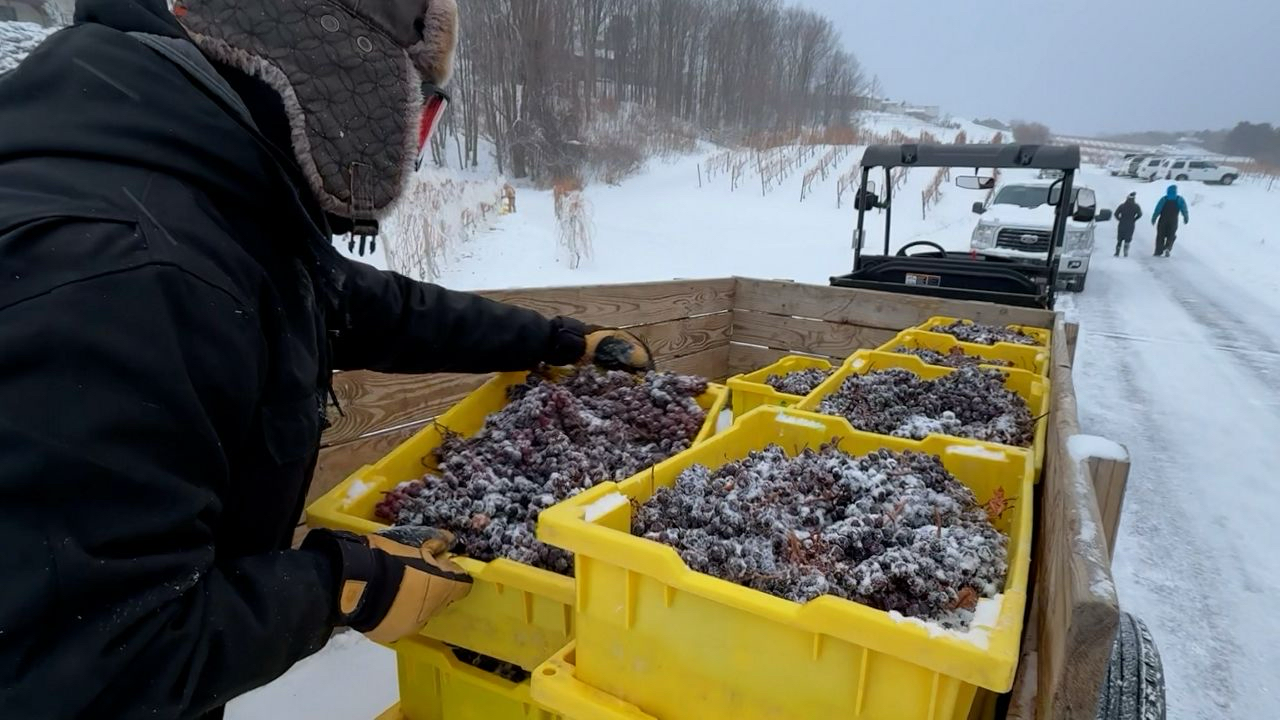
harvesting frozen grapes to make ice wine
Icewine vs. Eiswein vs. Ice Wine — A Note on Terminology
The terminology around frozen grape wines varies by country and carries legal significance. In Canada, icewine written as one word is a protected designation that requires the wine to be made from naturally frozen grapes harvested at minus eight degrees Celsius or colder. Mechanical freezing — using industrial equipment to freeze harvested grapes that were not frozen on the vine — is not permitted under Canadian icewine regulations. This distinction matters because mechanically frozen wines, sometimes called ice wines or iced wines, are produced at lower cost and at much higher volumes but do not achieve the same concentration or complexity as naturally frozen fruit.
German Eiswein carries similar legal requirements — the grapes must freeze naturally on the vine — and is classified at the Trockenbeerenauslese ripeness level, the highest designation in German wine law. Austrian Eiswein follows comparable regulations. When purchasing ice wine, the country of origin and the producer’s stated method are the most reliable indicators of whether the wine was made from naturally frozen fruit.
What Ice Wine Tastes Like and How to Serve It
Despite its sweetness, ice wine rarely tastes simple. Because freezing concentrates both sugar and acidity simultaneously, the wine carries a vivid tension between richness and freshness that prevents it from feeling heavy or cloying. Typical flavors include apricot, peach, honey, citrus marmalade, lychee, and tropical fruit, with the specific profile varying by grape variety and region. The texture is viscous, almost syrup-like, yet the acidity keeps the palate lifted and energetic through the finish.
Ice wine is typically served in small pours — the standard 375 milliliter half-bottle provides four to six generous tasting portions — well chilled at around eight to ten degrees Celsius. It pairs naturally with foie gras, blue cheese, fruit-based desserts, and fresh stone fruits. It can also be served alone as a dessert in itself, which at its best quality level is exactly what it is. A well-made Canadian Vidal or German Riesling Eiswein will continue to develop complexity in bottle for a decade or more, making it one of the more age-worthy sweet wines produced anywhere in the world.
Ice wine illustrates the same structural principle that governs all well-made sweet wines: sweetness must exist in tension with acidity to feel complete rather than flat. What makes ice wine distinctive is that both the sweetness and the acidity arrive not through winemaker intervention but through the physics of a winter cold enough to do the work itself. In that sense the wine is less a product of craft alone and more a collaboration between the winemaker and the season — which is why the best examples taste like something that could not have been made anywhere else, in any other year, under any other winter.
For a deeper explanation of how residual sugar shapes wine, see Sweetness in Wine in Sip.
Explore more culinary questions in Ask Foodie.