
The Quiet Math That Keeps the Lights On
Menu engineering, throughput, and why menus fail in service rather than in spreadsheets
There is a moment every operator recognizes. The room is full, the line is tight, tickets are stacked, and the restaurant feels busy in a way that should be profitable. The menu looks fine on paper. The items are popular. The sales reports show movement. And yet the math at the end of the night does not reflect the effort expended to earn it.
Food cost percentages offer very little comfort in that moment. The problem is not in the spreadsheet. It never was.
I have seen this pattern more than once. At Formaggio Grill, transitioning from a wine bar to a full restaurant, the space was generous enough that it created its own kind of pressure. When the infrastructure allows for it, the temptation is to fill it — more stations, more capability, more menu. Add a chef whose instinct is always yes, and the menu grows past what the operation can actually sustain. Not because anyone made a catastrophically bad decision, but because the system never pushed back. The warning arrived not in a pricing meeting but in service, when the line was overwhelmed and the tickets stopped moving cleanly.
That is where menu engineering stops being an academic exercise and becomes a leadership discipline. Because menus do not fail in spreadsheets. They fail in service.
The Familiar Framework and Its Limits
Most operators encounter menu engineering through a framework built around two axes: popularity and profitability. Items are sorted into stars, plowhorses, puzzles, and dogs. The framework is not wrong. It introduces discipline. It forces the recognition that not all menu items deserve equal protection.
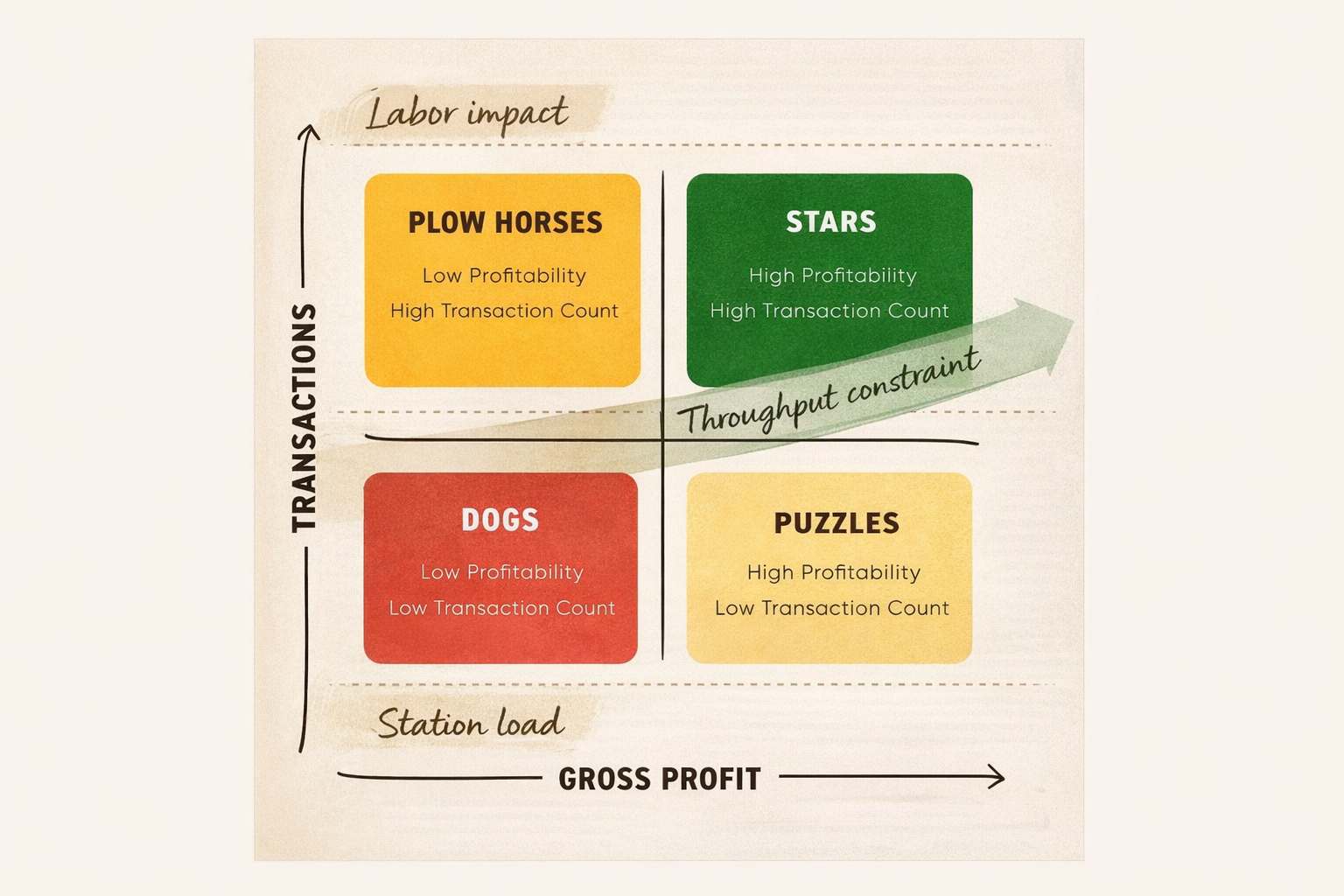
The classic menu engineering matrix. Useful as a diagnostic tool — but incomplete without labor impact, station load, and throughput context.
But like many tools borrowed from business theory, it misleads when applied without operational context. The model assumes that two items generating the same gross profit dollars are interchangeable. In real kitchens, they rarely are. What the matrix does not show is how those dollars are produced — at what cost to the line, at what burden to the station, at what speed through the system. That omission is where the framework breaks down for operators who have actually stood in a room during peak service and watched the math go wrong in real time.
The Cost Percentage Illusion
Food and liquor cost percentages are seductive because they feel precise. A lower percentage reads as a win, even when the dollars behind it are small. A dish with a twenty percent food cost can look virtuous on a report while contributing very little to the operation's actual financial health. Meanwhile, a dish with a higher cost percentage may quietly generate far more gross profit — simply because it sells at a higher price point and moves efficiently through the system.
Percentages reward cheapness. Restaurants survive on dollars. This distinction becomes unavoidable when capacity rather than demand is the limiting factor, which is the condition that most high-volume operations operate under on their best nights.
The people judging success by looking at spreadsheets are not in the room at 7:30 on a Friday night. The math shows up in the room before it shows up in the report — in ticket times, cold plates, and tables that don’t turn. By the time it reaches the report, the damage is already done.
Throughput: The Variable That Decides the Night
Every restaurant has a constraint. Sometimes it is obvious — a single grill, one skilled sauté cook on a Friday night, a fryer at capacity. Other times it is subtle: a plating step that requires two sets of hands, a sauce that cannot be rushed, a dish that demands three or four people touching the plate before it leaves the pass. When three or four people are involved in producing a single plate in a volume setting, the labor cost does not appear neatly on a food cost report. It appears as a bottleneck, a delayed ticket, a table held past its natural turn.
That constraint defines throughput — how many profitable plates the operation can produce in a given window without breaking. Throughput is not about speed for its own sake. It is about flow. Two items may show identical margins on paper. One moves through the line cleanly, finishes unattended, and clears the station. The other monopolizes attention, delays surrounding tickets, and slows the entire room. When demand peaks, the second item does not just underperform. It reduces the restaurant’s ability to generate revenue across the board.
This is why gross profit dollars per hour matter more than cost percentages per plate. A dish that produces strong margin in isolation but breaks the constraint during peak service is not a star. It is a liability wearing the right numbers.
When Space Creates the Illusion of Capacity
One of the less discussed causes of menu bloat is physical space. When a restaurant has the infrastructure — the square footage, the stations, the equipment — the temptation is to use it fully. More space suggests more capability. More capability suggests more menu. The logic feels sound until the operation runs at volume and discovers that infrastructure capacity and execution capacity are not the same thing.
At Formaggio Grill, the space made expansion feel natural. Combined with a chef whose answer to every idea was yes, the menu grew into something the kitchen could technically produce but could not sustain at pace. The items were not bad. The execution was not poor in isolation. What failed was the aggregate — the cumulative burden on the line when all of those items were in service simultaneously on a full night. That failure does not appear in a menu tasting. It appears in service, in the moment the line goes quiet for the wrong reasons.
Space is not a menu strategy. It is an operational resource. The discipline is in refusing to fill it simply because it is there.
It is easier to add than to subtract. Easier to defend a dish than to ask what it is costing the rest of the menu. That willingness to subtract — to remove something with loyal fans because the system cannot afford its footprint — is where menu engineering becomes leadership.
What the Classic Framework Misses
If the standard menu engineering matrix were revised for operators with real service experience, the quadrants would remain. Stars, plowhorses, puzzles, dogs — the categories are still useful as a starting point. But overlaid on that structure would be the variables that actually determine whether a restaurant survives peak service: labor impact, station load, and throughput constraint.
A star that overloads the constraint stops being a star during the hours that matter most. A plowhorse that moves cleanly through the line and frees station capacity may be more valuable than its margin suggests. A puzzle that requires skilled attention at a bottleneck station may be eliminating itself through its own execution demands. These readings require someone who has stood in the room when it is full, not someone reviewing the report the following morning.
Contribution margin is a better metric than cost percentage, but even contribution margin has blind spots if it is divorced from execution. A dish that produces strong gross profit dollars but requires disproportionate labor, skill concentration, or station load carries hidden costs that show up as fatigue, errors, slower turns, and eventually staff burnout. Menus are not just pricing documents. They are training manuals, labor plans, and workflow diagrams that happen to be printed on paper.
The Math That Shows Up in the Room
Menus do not fail because operators do not understand food cost. They fail because the menu asks more of the operation than the operation can sustainably give — and the people in the best position to see that ask are not in the room when it is being made.
Percentages make us feel informed. Dollars tell us whether the lights stay on. Throughput tells us whether the system can endure success. That third variable is the one that rarely makes it onto the report and always makes it onto the floor — in the pause between a ticket printed and a plate leaving, in the moment the line goes quiet, in the end-of-night math that does not reflect the room that was full two hours earlier.
The most profitable menus are rarely the most ambitious. They are the most considered. They understand that not every good idea deserves a permanent place, that clarity sells better than cleverness, and that removing a dish can sometimes increase total revenue even when that dish had loyal fans. That understanding is not a technical insight. It is a leadership decision that requires standing in the room often enough to know what the room is actually telling you.
If this essay resonates, Hospitality Between the Lines is just below.