

Knife Craft: How Blade Geometry Controls the Way Food Is Cut
Knife skills are often introduced as discipline. Culinary schools measure cuts carefully, chefs insist on uniformity, and young cooks spend long hours repeating the same motions. From the outside, this emphasis can appear aesthetic, as though the purpose of careful knife work is simply to produce attractive food.
In reality, the blade is performing mechanical work.
The governing principle of knife craft is straightforward: blade geometry determines how force enters an ingredient. The curve of the edge, the thickness of the spine, the taper toward the cutting edge, and the angle of the edge itself all shape the way steel separates plant fibers, proteins, and cellular structures.
When a knife enters food, it is not merely dividing the ingredient. It is directing how that ingredient will behave once heat, fat, seasoning, and acid begin acting upon it. A clean cut preserves structure and moisture; a rough cut crushes cells and releases water prematurely.
For this reason, knife craft belongs among the structural forces of cooking. The blade determines the geometry of the ingredient, and that geometry determines how the ingredient responds during cooking.
Understanding how knives work therefore requires examining both the tool and the shapes it produces.
Blade Geometry and Cutting Motion
One of the defining characteristics of a chef’s knife is the curved edge profile. That curve exists to support a specific cutting motion that has evolved in professional kitchens over centuries. As the blade moves forward and downward, the curvature allows the tip to remain in contact with the cutting board while the heel rises and falls.
This geometry creates a stable pivot point.
The curved edge anchors the blade, allowing the knife to rock smoothly through ingredients without lifting entirely from the board. Because the blade remains guided by the board itself, the cook can process herbs, onions, and vegetables rapidly while maintaining precise control.
The mechanism is mechanical rather than stylistic. A curved edge produces a pivot, the pivot produces a rocking motion, and the rocking motion produces speed without sacrificing stability.
Not all knives follow this pattern. Many Japanese knives use flatter blade profiles that favor push-cutting or slicing rather than rocking. In these techniques the blade travels forward through the ingredient rather than pivoting on the board.
In either case, the geometry of the blade determines the movement of the cook’s hand. Technique follows the design of the tool.
Blade Thickness, Taper, and Edge Angle
A chef’s knife appears thin, but its thickness changes subtly across the blade. Most knives are thickest along the spine and gradually taper toward the cutting edge. This taper solves one of the central problems of cutting: friction.
When the edge first enters an ingredient, the thin steel separates the surface fibers. As the blade moves deeper, the thicker portion of the knife gently spreads the ingredient apart. The taper reduces resistance as the blade travels downward.
The sequence is predictable. The thin edge initiates penetration, the tapered blade widens the separation, and friction decreases as the blade moves through the ingredient. When the taper is well designed, the knife glides rather than wedges.
Edge angle plays an equally important role. Western chef’s knives are commonly sharpened between fifteen and twenty degrees per side, while many Japanese knives use narrower angles. A narrower angle produces a thinner cutting edge that requires less pressure to penetrate food.
The trade-off is durability. Thinner edges are sharper but more fragile, while thicker edges resist damage but require slightly more force. Knife design therefore balances precision and resilience according to the tasks the blade is expected to perform.
Together, taper and edge angle determine how efficiently the blade transfers force from the cook’s hand into the ingredient.
Western and Japanese Knife Philosophies
Two major knife traditions dominate professional kitchens: Western and Japanese. Their differences reflect the culinary environments in which they evolved.
Western knives developed in kitchens that required versatility. A single knife might chop herbs, slice meat, break down poultry, and process dense root vegetables throughout the day. Durability therefore became a primary design priority.
Western blades tend to feature thicker spines and slightly wider edge angles. These features support stronger cutting edges capable of handling heavy work without chipping.
Japanese knives evolved under different priorities. Traditional Japanese cuisine places extraordinary emphasis on precision cutting, particularly when working with seafood and vegetables. Clean slices preserve delicate textures and present ingredients with clarity.
Japanese knives therefore emphasize thin blades and narrow edge angles. Reduced blade thickness lowers resistance and allows ingredients to separate with minimal pressure.
Both traditions seek the same goal: efficient transfer of force from hand to ingredient. They simply balance durability and precision differently.
The Language of Classical Cuts
Professional kitchens rely on a shared vocabulary to describe the shapes produced by knife work. These classical cuts are not decorative conventions. They exist because ingredient geometry determines how food cooks.
A cook who requests julienne carrots or a brunoise of shallots is communicating more than appearance. The instruction defines how quickly heat will penetrate the ingredient, how rapidly moisture will escape, and how the ingredient will distribute flavor throughout the dish.
Over time, these shapes became standardized so that cooks could predict how ingredients would behave once heat was applied.
Knife craft therefore includes both the mechanics of the blade and the geometry those mechanics produce.
Julienne
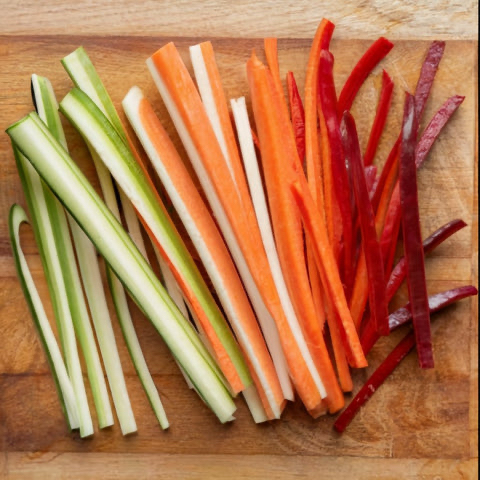
julienne carrot knife cut culinary technique
The julienne cut produces thin matchstick shapes typically measuring about three millimeters by three millimeters in cross section and roughly four to five centimeters in length. This geometry dramatically increases surface area while minimizing the distance between the exterior and the center of the ingredient.
Because heat penetrates quickly, julienne vegetables cook rapidly without losing their structural identity. Carrots, leeks, ginger, and bell peppers are commonly cut this way when quick sautéing or stir-frying is required.
The cut produces a predictable outcome: rapid cooking with preserved shape and texture.
Batonnet
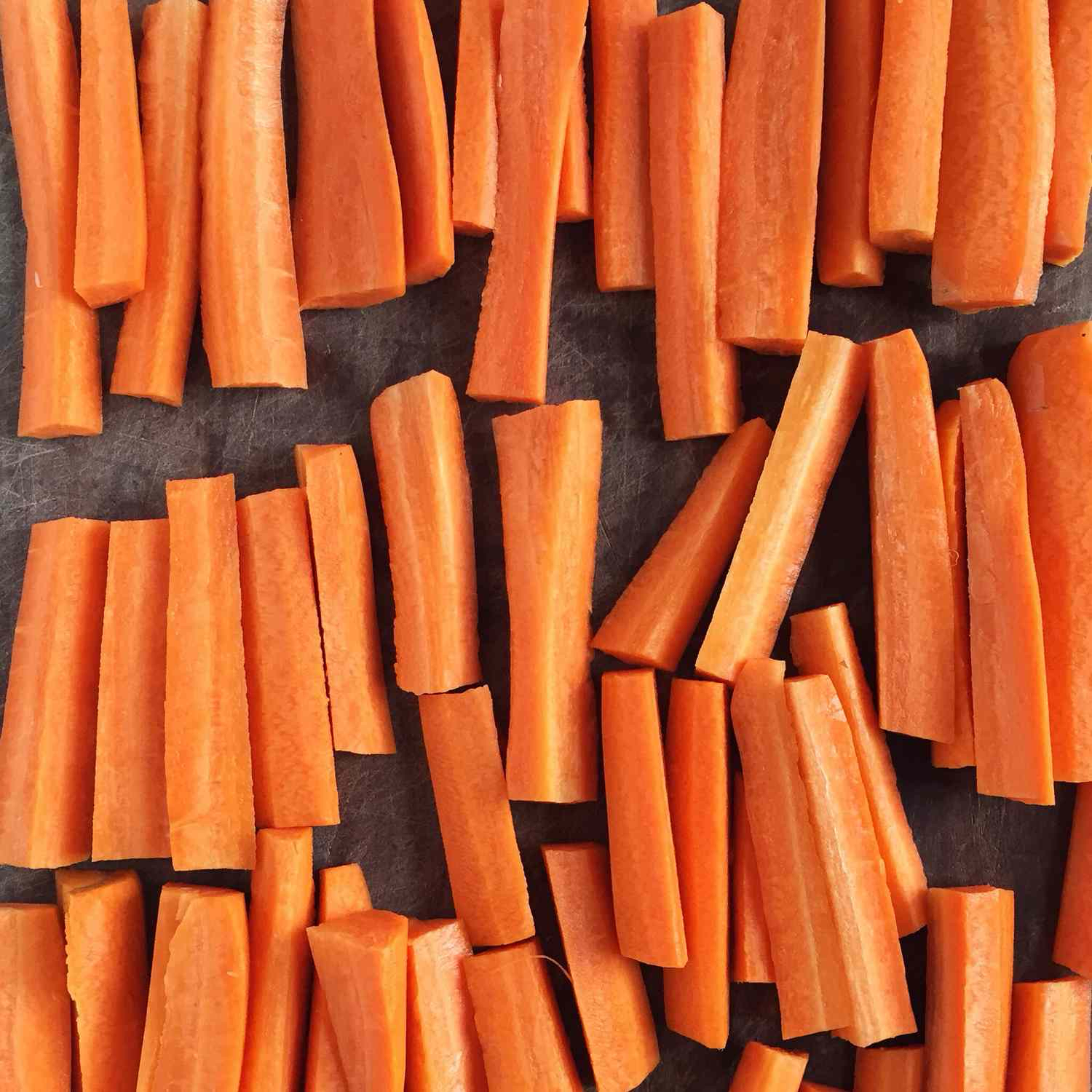
batonnet carrot knife cut culinary technique
The batonnet cut forms thicker rectangular sticks, generally about six millimeters by six millimeters and approximately five centimeters long. This geometry increases surface area while preserving more interior mass.
Because the center of the ingredient remains larger, heat penetrates more slowly than with julienne cuts. The exterior softens while the interior retains firmness.
Batonnet vegetables therefore maintain structure during roasting, blanching, or sautéing. The cut provides texture while still allowing seasoning and heat to reach the ingredient efficiently.
Brunoise
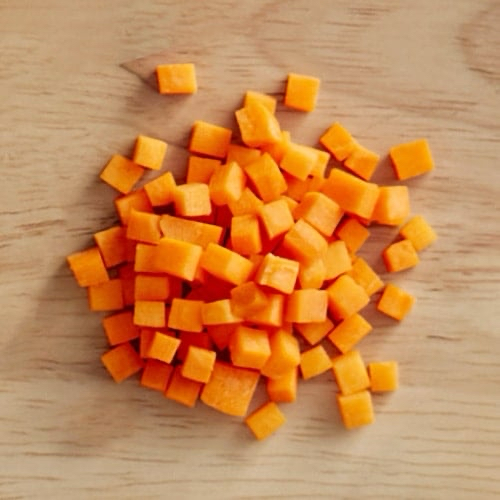
brunoise dice carrot knife cut culinary technique
The brunoise cut reduces ingredients into small cubes roughly three millimeters on each side. Achieving this shape requires first cutting the ingredient into julienne strips and then rotating them before slicing across the bundle.
The resulting cubes release moisture and aromatic compounds quickly because their surface area is high relative to their size. As they cook, they disperse evenly into sauces, soups, or aromatic bases.
A finer variation known as fine brunoise produces cubes closer to one or two millimeters. At that scale the ingredient contributes flavor without maintaining visible structure.
The cut therefore determines whether the ingredient remains present or dissolves into the background of the dish.
Paysanne
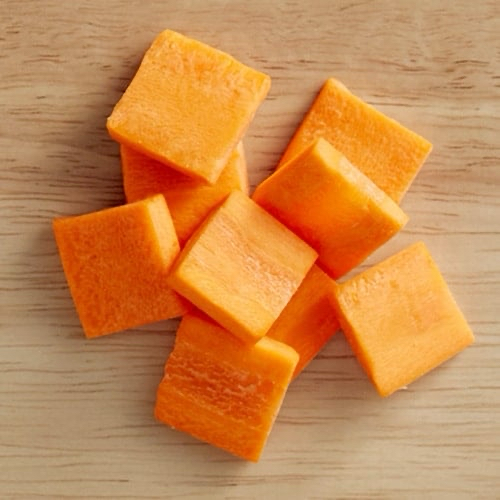
paysanne carrot knife cut culinary technique
The paysanne cut produces thin flat pieces that follow the natural shape of the ingredient. Carrots, for example, may be sliced into small squares, triangles, or half-moons depending on their original form.
Thickness typically remains around one to two millimeters. This allows the pieces to cook quickly while maintaining a rustic appearance.
Paysanne cuts appear frequently in soups and vegetable stews where speed of cooking matters more than strict geometric precision.
Chiffonade
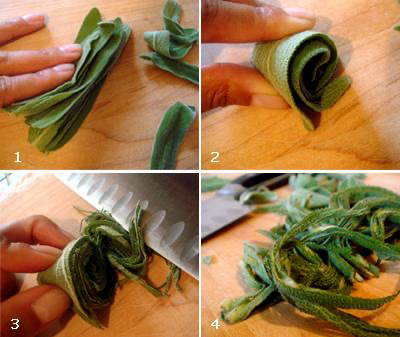
chiffonade leafy herbs and greens knife cut culinary technique
Leafy herbs and greens require a different approach. Rather than cutting rigid structures, the knife must slice delicate leaves without crushing them.
The chiffonade technique stacks leaves, rolls them into a tight bundle, and slices across the roll to create thin ribbons. Basil, mint, and spinach are commonly prepared this way.
The resulting ribbons release aromatic oils quickly while maintaining the visual identity of the leaf. The cut distributes fragrance across a dish without overwhelming it.
Edge Maintenance and Cutting Efficiency
Even the most carefully designed blade cannot perform properly without a sharp edge. Under magnification, the edge of a knife resembles a narrow ridge of steel rather than a perfect line.
During use that ridge gradually bends or develops microscopic wear as it contacts cutting boards and ingredients. As deformation increases, resistance increases.
Edge deformation increases cutting resistance, and increased resistance forces the cook to apply greater pressure. Greater pressure reduces control and damages ingredient structure.
For this reason sharpening and honing remain essential parts of knife craft. Honing rods realign the edge by pushing the bent ridge of steel back into position. Sharpening stones remove small amounts of metal to recreate the edge itself.
Honing preserves alignment while sharpening restores geometry. Together they maintain the knife’s ability to transfer force efficiently into food.
Knife Craft as Culinary Architecture
By the time ingredients reach heat, much of their behavior has already been determined by the blade. Knife geometry influences how cleanly fibers are separated, how much moisture escapes, and how evenly ingredients cook.
A clean cut preserves structure and limits unnecessary moisture loss. Controlled geometry ensures that ingredients cook evenly and release flavor in predictable ways.
These details shape the reactions that occur later in the pan. Browning, texture, and flavor development all begin with the work performed by the knife.
Knife craft therefore belongs alongside heat, fat, acid, and seasoning as one of the foundational forces of cooking.
Heat transforms ingredients.
Fat carries flavor.
Acid restores balance.
Seasoning clarifies taste.
Knife work determines how ingredients enter that system.
Once this relationship becomes visible, the blade is no longer simply a tool used during preparation.
It becomes part of the architecture of cooking itself.